
How Acoustic and Lighting Strategies Reduce Sensory Overload in Schools
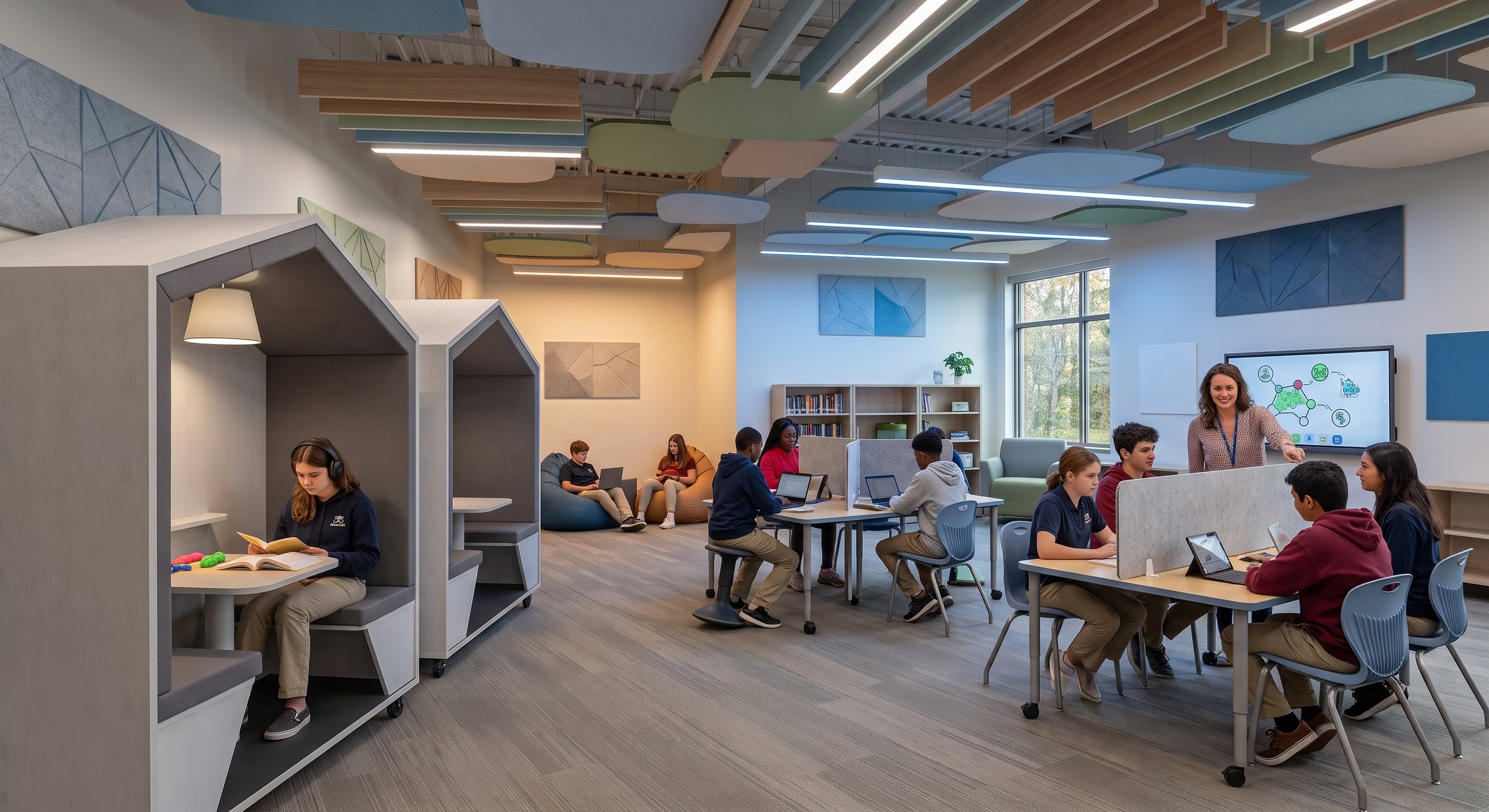
For many neurodivergent students, the physical world is turned up to a ten at all times. The subtle flicker of a standard fluorescent light or the hum of an HVAC unit bouncing off cinderblock walls isn't just a minor annoyance—it is a physical barrier to learning.
Neurotypical brains possess a mechanism called "sensory gating," which allows them to automatically filter out irrelevant background stimuli and habituate to their environment. However, research in occupational therapy and neuroscience indicates that students with Autism Spectrum Disorder (ASD), ADHD, and Sensory Processing Disorder (SPD) often lack this automatic filtration. Before a student can engage with a complex curriculum, decode a text, or solve a math problem, their nervous system must feel physiologically safe. When an environment triggers the sympathetic nervous system (the "fight, flight, or freeze" response), the amygdala hijacks the brain, and access to the prefrontal cortex—where logical learning and emotional regulation occur—halts entirely.
The Physics of Sensory Friction and Cognitive Load
John Sweller’s widely accepted Cognitive Load Theory dictates that human working memory has a strictly limited capacity. In educational design, we categorize this into intrinsic load (the difficulty of the task itself) and extraneous load (distractions that do not aid learning).
A poorly designed physical environment creates massive extraneous cognitive load. When a student’s brain is forced to consciously and continuously process environmental "noise"—both visual and auditory—they have significantly less cognitive bandwidth available for executive functioning, academic processing, and emotional regulation. Over a six-hour school day, this sensory friction leads to a high "allostatic load" (the physiological wear and tear on the body from chronic stress), resulting in profound exhaustion, end-of-day meltdowns, and chronic dysregulation.
Acoustics: Dampening the Institutional Echo and The Lombard Effect
Hard VCT tile floors, painted cinderblock walls, and metal desk frames act as acoustic mirrors, creating highly reverberant spaces. For a student with auditory processing differences or ASD, distinguishing a teacher's direct instruction from the background reverberation of shifting chairs, hallway chatter, and HVAC hum requires exhausting, continuous effort. This is known as poor "auditory figure-ground discrimination."
When rooms are highly reverberant, speech consonants (like t, k, p, s) become smeared into the vowels of previous words. The American National Standards Institute (ANSI) specifically recommends that classroom reverberation time (RT) should not exceed 0.6 seconds to ensure speech intelligibility. Yet, many traditional classrooms operate at double that rate. This triggers the "Lombard Effect"—the subconscious tendency of speakers to raise their voices in noisy environments, which causes students to talk louder, creating a compounding cycle of chaotic noise.
Acoustic Interventions: Addressing reverberation time is critical for inclusive design. Integrating wall-mounted acoustic baffles, suspended acoustic clouds, felt dividers on workstations, and soft flooring solutions absorbs errant sound waves rather than reflecting them. By drastically reducing the room's echo, districts increase the Speech Transmission Index (STI), ensuring every student can hear the lesson clearly. Furthermore, this creates a significantly calmer auditory environment that naturally lowers the ambient volume of student voices.
Lighting: From Static Glare to Responsive Illumination
Standard fluorescent lighting, ubiquitous in aging school buildings, is a documented hazard for neurodivergent populations. Fluorescent tubes operate using a ballast that creates a sub-visual pulse, typically flickering at 100 to 120 Hz (hertz). While neurotypical brains cannot consciously detect this pulse, studies in environmental psychology and vision science (such as the foundational research by Arnold Wilkins) have shown that individuals with autism often process this flicker continuously.
This causes the brain to constantly rapidly adjust, leading to severe visual stress, physical discomfort, eye strain, migraines, and an increase in repetitive self-stimulatory behaviors. Furthermore, standard fluorescent lights emit a rigid, cool-white color temperature that can disrupt circadian rhythms.
The Phase-Out Strategy: Facilities directors must prioritize the transition to dimmable, full-spectrum LED lighting, which provides a continuous, flicker-free stream of light. Crucially, lighting should not be controlled by a single, static on/off switch. Responsive lighting allows educators to map the illumination to the specific cognitive task. Research on lighting in educational settings shows that lowering light levels and warming the color temperature reduces visual strain and calms the nervous system during independent reading, while raising the brightness to a cooler, blue-enriched temperature can increase alertness for energetic collaborative work.
By addressing the invisible infrastructure of sound and light, school district leadership, IT, and AV directors can systematically eliminate the structural sensory friction that derails the academic day.