
A School District’s Guide to Neurodiverse Classroom Design
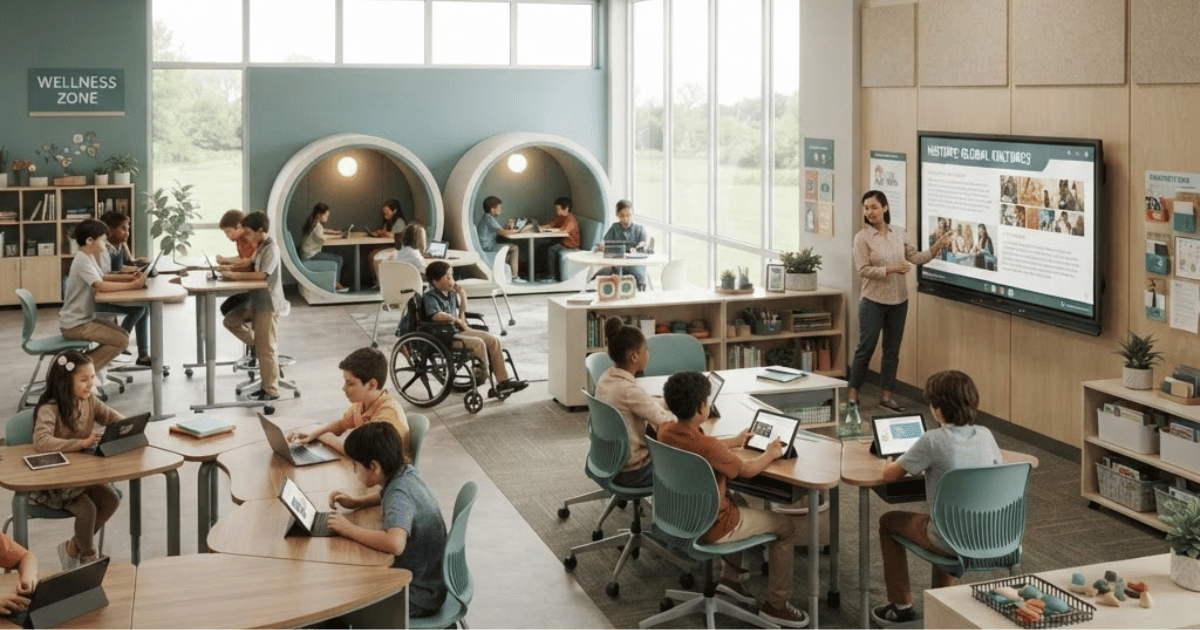
For generations, school architecture was defined by an industrial-era layout: rows of forward-facing desks contained within four rigid, cinderblock walls. This "factory model" of education was designed primarily for direct instruction, behavioral compliance, and rote memorization. Today, forward-thinking educational leaders recognize the philosophy brilliantly pioneered by Reggio Emilia: the physical space acts as the "third teacher." But as pedagogical models shift toward collaborative, student-centered, and project-based learning, our physical facilities must evolve to meet the neurological realities of modern student populations.
Moving Beyond the Deficit Model of Education
Neurodiversity—a term coined by sociologist Judy Singer to describe the natural variation in human cognitive functioning, including ADHD, Autism, Dyslexia, and Dyspraxia—has historically been viewed through a medical "deficit" lens. The traditional approach in special education often asked a fundamentally flawed question: How do we force this student to FIT into this room?
This mindset led to a heavy reliance on pull-out programs, isolating students from their peers. Alternatively, it expected neurodivergent students to "mask"—a well-documented psychological phenomenon where individuals consciously suppress their natural neurological responses (like stimming or needing to move) to appear neurotypical. Clinical research shows that chronic masking leads to severe autistic burnout, anxiety, and depression, draining the cognitive resources needed for actual academic learning.
A “neuro-intelligent” ecosystem design embraces the social model of disability, which posits that individuals are often disabled not by their neurology, but by an environment that is hostile to their needs. It asks a better, more structural question: How do we design this room to SUPPORT the student's autonomic nervous system?
This represents the physical, architectural application of Universal Design for Learning (UDL), a framework developed by researchers at CAST. UDL emphasizes providing multiple means of engagement, representation, and action. Just as the "curb-cut effect" in urban planning proves that a wheelchair ramp benefits the delivery person with a hand truck or a parent with a stroller just as much as the wheelchair user, neuro-intelligent environments create a superior, lower-stress learning environment for the ENTIRE student body. When we reduce sensory friction, we lower the baseline stress levels for everyone in the room.
The Strategic ROI of Neuroinclusive Architecture
District administrators, facility planners, and superintendents often view inclusive design as a niche requirement restricted to specific special education wings or self-contained classrooms. Structurally and financially, this is a costly misconception.
The modern general education classroom must be a dynamic, multi-zone ecosystem. By abandoning the "one-size-fits-all" layout in favor of High-Focus Zones, Active Learning Zones, and Sensory Reset Spaces, School Districts can see measurable, district-wide returns that easily justify the upfront investment. These benefits include:
Decreased Behavioral Incidents Through Neuroception: Dr. Stephen Porges’ Polyvagal Theory explains "neuroception"—the nervous system's subconscious evaluation of an environment as safe or dangerous. Disruptive behavior is rarely defiance; it is most often a secondary symptom of sensory overload or unmet physiological needs. When environments signal safety, and students have spaces to self-regulate before reaching a sympathetic nervous system crisis point, office referrals, classroom evacuations, and disciplinary disruptions drop significantly.
Reduced Teacher Burnout and Attrition: Educators are facing a retention crisis, driven in part by the exhausting cognitive load of continuous classroom management. Environments that naturally support student focus and self-regulation require significantly less behavioral management from educators. Teachers spend less time policing posture and mitigating environmental triggers, and more time facilitating actual learning. This directly impacts staff morale and long-term retention.
Improved Resource Allocation and Scalability: Designing spaces correctly the first time reduces the need for expensive, ad-hoc physical accommodations, reactive structural modifications, or highly individualized equipment later. It scales inclusion across the district, ensuring that universal supports are built into the baseline infrastructure rather than treated as expensive add-ons.
Designing for neurodiversity isn’t about isolation; it is about belonging by design. When educational environments are physically rigid, they unintentionally exclude, sending a silent message to students that they do not fit. When physical spaces are responsive, adaptive, and intentionally designed, EVERY learner is given the infrastructure they need to thrive.