
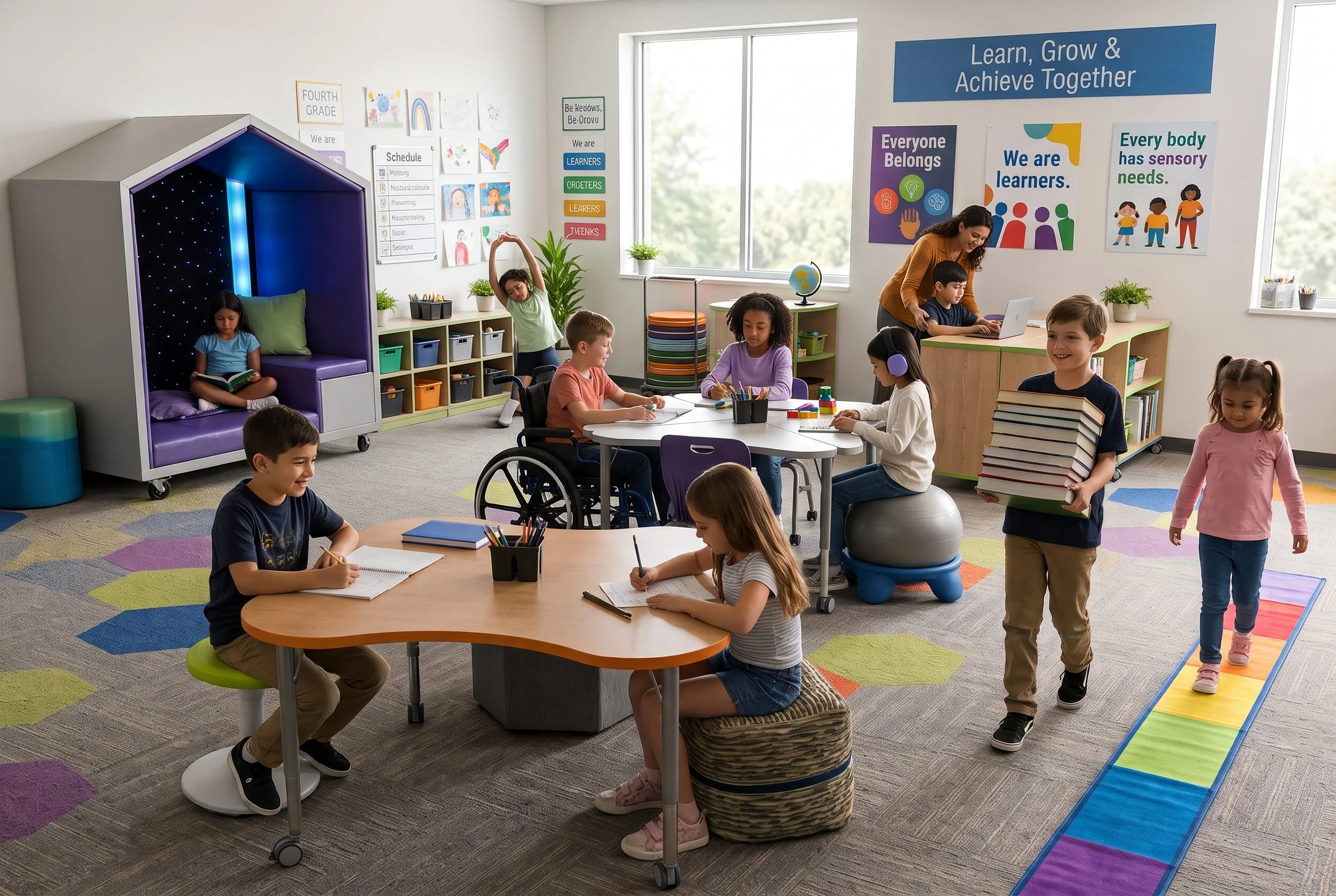
When we think about the five senses, we naturally think of sight, hearing, touch, taste, and smell. These familiar senses help us experience and understand the world around us.
But what if two of the most important sensory systems for learning are ones we rarely talk about?
The vestibular and proprioceptive systems play essential roles in how children move, maintain balance, understand their bodies, regulate their activity levels, and participate in everyday classroom activities.
Although these systems are less familiar than the traditional five senses, they are fundamental to how children interact with their surroundings. Understanding them can help educators create more inclusive, comfortable, and effective learning environments.
The Vestibular Sense: Our Internal Balance and Movement System
Imagine trying to walk across a room, sit upright at a desk, or turn your head to look at a teacher without knowing which direction your body is moving.
That's where the vestibular system comes in.
Located in the inner ear, the vestibular system detects head movement and position relative to gravity. It helps the brain coordinate balance, posture, eye movements, and spatial orientation.
For children, the vestibular system plays an important role in activities such as:
Sitting upright and maintaining posture during lessons.
Walking, running, jumping, and navigating playground equipment.
Coordinating head and eye movements while reading or following a moving object.
Maintaining balance when changing positions or moving around the classroom.
Participating confidently in physical activities and movement-based learning.
However, children process vestibular information differently. These differences can influence how a child participates in everyday learning activities.
For example, a student who frequently rocks in their chair or gets up to move may be seeking movement-related sensory input. Another student may prefer stable seating and become anxious during activities involving balance or rapid movement.
Sensory-friendly classrooms recognize that movement needs are not the same for every child.
Rather than expecting every student to remain completely still, educators can provide safe, appropriate opportunities for movement while maintaining a structured and supportive learning environment.
The Proprioceptive Sense: Knowing Where Our Bodies Are
Close your eyes and touch your nose with your finger.
You can do this without looking because your proprioceptive system tells your brain where your arm, hand, and fingers are positioned.
Often described as our body's internal positioning system, proprioception relies on sensory receptors in muscles, tendons, and joints. These receptors provide continuous information about body position, movement, and physical effort.
For children, proprioception supports many everyday classroom activities, including:
Holding pencils and controlling writing pressure.
Using scissors, manipulatives, and classroom tools.
Navigating around desks, chairs, and classmates.
Coordinating movements during sports, play, and physical education.
Judging how much force to use when pushing, pulling, lifting, or handling objects.
Maintaining coordinated posture during seated activities.
Some children seek additional physical input through activities involving pushing, pulling, squeezing, stretching, or applying pressure. A student might lean heavily against furniture, press firmly when writing, enjoy carrying classroom materials, or gravitate toward activities involving physical resistance. Others may have difficulty judging force or coordinating movements, making everyday tasks such as handwriting, handling delicate objects, or navigating crowded spaces more challenging.
These behaviors have many possible explanations and should not automatically be interpreted as sensory-processing difficulties.
However, understanding proprioception helps educators recognize that some children may benefit from additional movement opportunities and carefully selected physical activities.
Why These Two Senses Matter in Sensory-Friendly Learning Environments
Traditional classrooms have often emphasized sitting quietly, maintaining attention, and minimizing movement. But children do not all learn, move, or process sensory information in the same way.
A classroom that works well for one student may feel physically uncomfortable, overstimulating, or insufficiently engaging for another. The vestibular and proprioceptive systems contribute to several abilities that support classroom participation.
1. Supporting Attention and Engagement
Appropriate movement opportunities can help some children maintain alertness, engage with classroom activities, and return to learning tasks feeling more prepared to participate.
For example, a brief movement break or access to alternative seating may help a student who finds prolonged sitting difficult.
However, movement is not universally calming or beneficial in the same way. The type, intensity, and timing of sensory input should reflect each child's individual needs.
2. Supporting Emotional and Sensory Regulation
Sensory regulation involves how children respond to and manage information from their bodies and surrounding environments.
For some students, activities that provide proprioceptive input, such as pushing, stretching, or using resistance materials, may contribute to a feeling of physical comfort and organization.
Likewise, gentle, predictable movement may be helpful for certain children, while others may find it uncomfortable or overstimulating.
Providing a choice of sensory experiences allows students to explore strategies that work for them.
3. Encouraging Physical Confidence and Independence
Balance, body awareness, and motor coordination influence how confidently children move through their environments.
Classrooms that incorporate accessible movement areas, stable furnishings, appropriately designed activity stations, and clear circulation pathways can help children participate more independently.
This becomes particularly important in early childhood education, where movement and physical exploration are closely connected to development and play.
4. Creating More Inclusive Learning Experiences
Sensory-friendly design is especially relevant for students with autism, ADHD, sensory-processing differences, and certain developmental or motor coordination challenges.
However, the benefits of thoughtful environmental design are not limited to students with identified disabilities.
All students have sensory needs, and those needs may vary throughout the day.
A flexible learning environment gives educators more ways to respond to those differences without requiring every child to engage with the classroom in exactly the same way.