
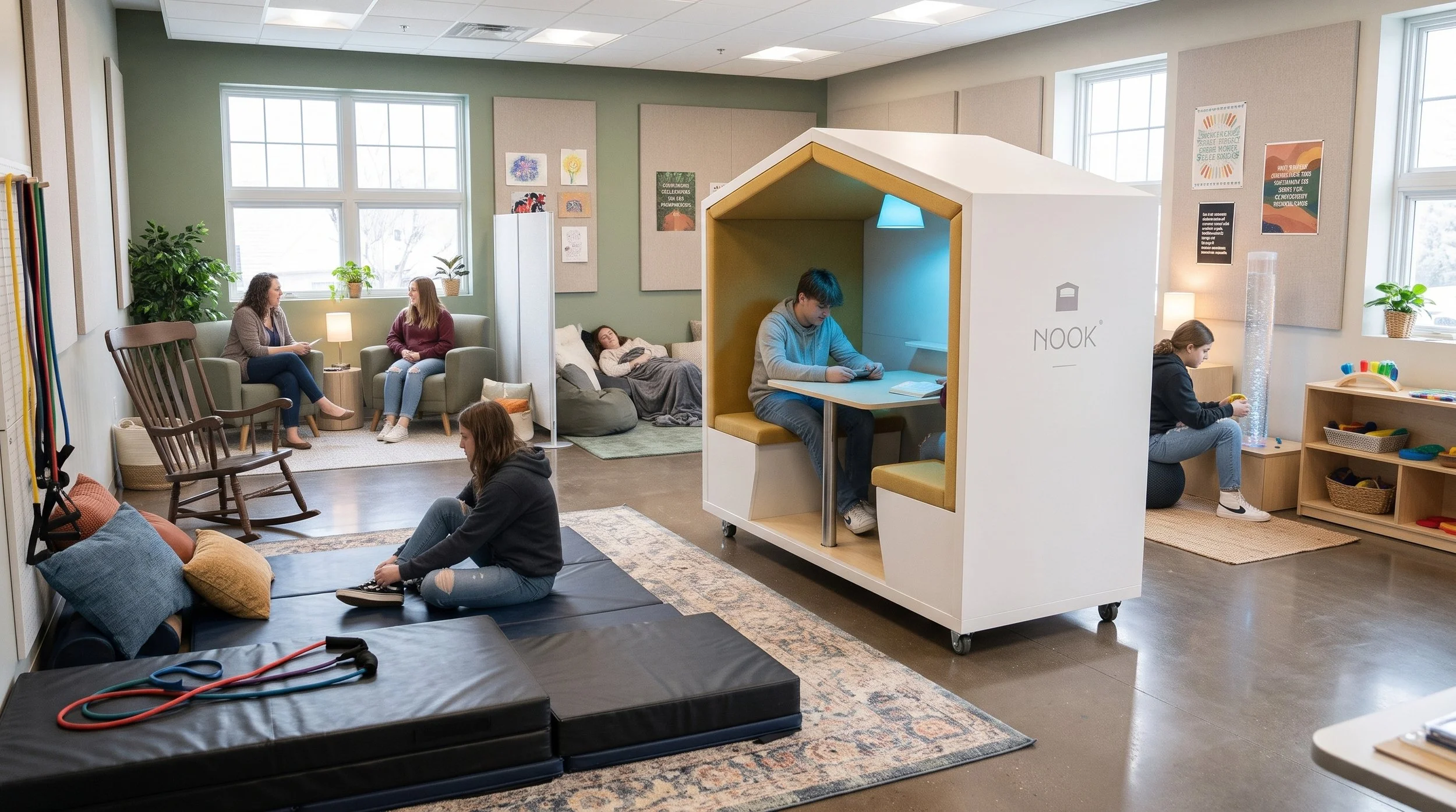
K-12 district leaders face unprecedented challenges: rising student anxiety, escalating behavioral dysregulation, and compounding losses in instructional time. Traditional "chill-out" corners or isolated disciplinary holding areas fail to address the root neurobiological needs of dysregulated students. When students are in sensory or emotional distress, an unstructured room cannot deliver the targeted physiological support required for de-escalation.
Research on inclusive K-12 wellness center design proves that spatial zoning—structuring retreat and sensory spaces into distinct, purpose-driven micro-environments—is essential for supporting neurodivergent students, including those with Autism, ADHD, trauma histories, or sensory processing differences.
By pairing spatial zoning with Universal Design for Learning (UDL) principles, superintendents, principals, and student services directors can shift wellness facilities from reactive holding zones into proactive, trauma-informed ecosystems that restore instructional time and lower disciplinary referrals.
The 6 Essential K-12 Wellness Zones
1. Sensory Retreat (Low-Stimulation Sanctuary)
The Design: A sound-isolated acoustic pod or curtained nook featuring dimmable LED lighting, soft floor cushions, weighted lap pads, and zero visual clutter.
The Leadership Impact: Provides a safe, ultra-low-stimulation retreat for students experiencing acute sensory overload, panic, or meltdowns. It allows de-escalation to occur privately without escalating surrounding classrooms or public hallways.
UDL Alignment:
Engagement (Minimizing Threats & Self-Regulation): Protects student dignity while de-escalating sympathetic "fight-or-flight" nervous system states.
2. Tactile & Somatic Grounding Zone
The Design: Outfitted with heavy-work equipment (rocking chairs, compression seats, resistance bands, crash pads), floor mats, rhythmic sand trays, and guided stretch cards.
The Leadership Impact: Gives students requiring proprioceptive or vestibular input a constructive, safe outlet to discharge physical tension. This somatically interrupts panic or dissociative states before behavioral crises occur.
UDL Alignment:
Action & Expression: Provides physical, movement-based modalities for discharging stress and regulating physical arousal.
3. Expressive Lab
The Design: An innovative area equipped with journaling supplies, drawing/art media, tactile sculpting materials, and quiet reflective workstations.
The Leadership Impact: Establishes non-verbal channels for students to externalize high-intensity emotions. This eliminates the pressure for immediate verbal articulation when a student is cognitively overwhelmed.
UDL Alignment:
Action & Expression: Offers multi-modal, creative channels for processing and communicating internal emotional states.
4. Calm Corner
The Design: A low-stimulation, ergonomic workspace equipped with task lighting, acoustic privacy dividers, and low visual distraction.
The Impact: Functions as an essential transitional bridge. Once a student's nervous system is regulated, this zone allows them to stabilize and complete quiet, focused reflection or academic catch-up work before returning to class.
UDL Alignment:
Engagement: Supports sustained focus, mindfulness, and gradual cognitive re-engagement.
5. Resource Hub
The Design: An accessible informational display featuring self-regulation guides, SEL coping toolkits, visual emotion scales, and student wellness resources.
The Leadership Impact: Empowers student self-advocacy within a Tier 1 and Tier 2 MTSS (Multi-Tiered System of Supports) framework, equipping learners with portable coping strategies they can apply in the regular classroom.
UDL Alignment:
Representation: Displays self-regulation techniques and mental health resources in clear, visual, user-friendly formats.
6. Consultation Station (Private Re-Entry & Debrief Zone)
The Design: A private, acoustic-buffered area featuring 45-degree angled armchairs, soft visual partitions, visual feeling scales, and discreet hydration stations.
The Leadership Impact: Facilitates trauma-informed, low-pressure conversations with school counselors, clinicians, or administrators. Separating the emotional crisis phase from the cognitive reflection phase ensures smooth, successful transitions back to academic instruction.
UDL Alignment:
Engagement & Action & Expression: Fosters psychological safety, restorative communication, and collaborative re-entry planning.
Strategic Value for K-12 District Leaders
Investing in evidence-based wellness zoning yields measurable returns across core district performance metrics:
Maximizing Instructional Time: Differentiated sensory zones accelerate de-escalation, reducing the duration of student distress and returning learners to class significantly faster.
Suspension & Disciplinary Mitigation: Replacing punitive isolation with trauma-informed spatial zoning directly lowers office discipline referrals (ODRs) and out-of-school suspensions.
Trauma-Informed Psychological Safety: Semi-private, zoned spaces protect vulnerable students from feeling observed or stigmatized during emotional crises.
MTSS & Special Education Alignment: Zoned wellness spaces provide measurable environmental accommodations that support IEP, 504, and Tier 2/3 behavioral intervention goals.
Driving Systemic Impact
Transforming district mental health support requires moving beyond reactive measures. When district leaders design wellness spaces that proactively accommodate neurodiverse sensory profiles, they remove the burden of adaptation from the student. The result is a campus environment where safety, emotional resilience, and academic success go hand-in-hand.
Core Research & Published SourcesSensory Spaces & Self-Regulation: Edutopia. How to Create a Sensory Space for Neurodivergent Students.School Occupational Therapy Protocols: The OT Toolbox. Sensory Room Rules, Protocols, and Guidelines for Schools.Sensory Facility Design Frameworks: Fun & Function. How to Create a Sensory Space: A Complete Guide.Trauma-Informed Educational Architecture: HMC Architects. Designing for Holistic Student Wellness: A Trauma-Informed Approach.Retreat Space Planning for Schools: Cuningham Group. Trauma-Informed Design: Strategies for Educational Wellness Spaces.Neurodiversity Stocktake & Environmental Design: Neurodiversity in Education Project. Sensory-Friendly Spaces & Stocktake Tools.Overstimulation Prevention Research: Liberty University Academic Repository. Sensory Room Design to Prevent Overstimulation.